
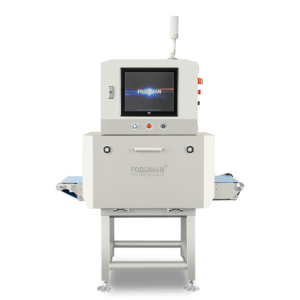
Density variations within packaged food often escape visual inspection. An X-Ray machine reveals these differences by measuring how radiation passes through the product. Dense fragments absorb more radiation than surrounding food, creating contrast in the resulting image. Foodman Vision applies this principle to detect contaminants without opening sealed packages.
The Physics Behind Radiation Absorption
X-ray photons interact with matter in predictable ways. Heavier elements absorb more photons than lighter ones. This absorption follows an exponential relationship with material thickness and density. A dense contaminant leaves a shadow on the detector array.
Beam energy must match the product being inspected. Lower energy improves contrast for thin items but struggles with thick foods. Higher energy penetrates deeper but reduces sensitivity to small fragments. Operators select settings based on the specific application.
Scattered radiation degrades image quality. It bounces off surrounding surfaces and reaches the detector from unintended angles. Collimators and shielding reduce this effect. Proper machine design minimizes scatter without blocking the primary beam.
Signal Processing and Image Reconstruction
The detector converts incoming photons into electrical signals. These signals undergo amplification and digitization before reaching the processing unit. Noise from electronic components can obscure weak signals. Filtering algorithms separate meaningful data from background interference.
Reconstruction software builds a two-dimensional image from the detector readings. Edge enhancement highlights boundaries between materials. Contrast adjustment makes subtle density differences visible to the operator. These steps occur in real time on high-speed lines.
Advanced processing can suppress false positives caused by product texture. Bones, cartilage, and salt crystals may mimic contaminants. Machine learning models trained on real samples improve discrimination. Foodman Vision incorporates such methods to reduce unnecessary rejections.
Contaminant Types and Their Detectability
Metal fragments produce the strongest signals due to high atomic number. Glass and stone also appear clearly in most food matrices. Stainless steel presents moderate contrast depending on its alloy. Smaller particles become harder to see as product density increases.
Bones vary widely in detectability. Dense cortical bone is easier to identify than thin, flexible fragments. Fish bones can be particularly challenging in thick fillets. Soft tissue and fat offer little contrast against similar densities.
Plastic and rubber contaminants are generally invisible to X-ray. Their low density matches many food components. For these materials, alternative inspection methods may be required. No single technique addresses every possible foreign object.
Conveyor Dynamics and Product Flow
Product spacing affects image clarity. Overlapping items create dense regions that hide small contaminants. Gaps allow the detector to reset between readings. Consistent spacing improves both sensitivity and throughput.
Belt speed determines exposure time. Faster movement reduces the number of photons reaching the detector. This lowers signal strength and image resolution. Slower speeds improve detection but limit production capacity. The optimal speed balances both factors.
Product orientation can change detection outcomes. A flat fragment presents more area to the beam than an upright one. Random orientation makes sensitivity unpredictable. Guiding rails or vibratory feeders align products before inspection to standardize conditions.
Human Factors in Inspection Operations
Operators monitor screens for hours at a time. Fatigue reduces attention to subtle image variations. Rotating tasks and scheduled breaks help maintain focus. Clear alarm thresholds prevent information overload.
Training must cover both normal and abnormal images. Recognizing artifacts from actual contaminants takes practice. Simulated test pieces provide hands-on experience. Regular refresher sessions keep skills sharp.
Documentation of operator actions supports traceability. When a rejection occurs, the reason should be recorded. Supervisors review these logs to identify patterns. Consistent record-keeping turns individual decisions into useful data.
Data Logging and Continuous Improvement
Every inspection generates data. Time stamps, rejection counts, and product codes accumulate over shifts. Analyzing these records reveals trends that human observation might miss. A gradual increase in false rejects may signal equipment drift.
Correlating inspection data with maintenance records adds insight. If detections spike after a blade change, the equipment may be shedding fragments. If false alarms rise after a recipe update, the product effect has changed. Such connections guide corrective actions.
Long-term data supports validation and audits. Historical performance demonstrates that the process remains under control. Reviewing past rejections helps refine sensitivity settings. This cycle of measurement and adjustment improves reliability over time.
OEM/ODM Options and Commercial Support
Foodman Vision offers OEM and ODM services for food inspection equipment. Conveyor dimensions, aperture size, rejection mechanism, and control interface can be adapted to a customer’s line. Software settings and data outputs can also be customized. For B2B buyers, this includes sample testing, installation guidance, operator training, and spare parts support. Such an approach helps integrate inspection into existing production workflows without forcing a fixed configuration.
From Detection to Defense
An X-ray machine serves as one layer within a broader food safety effort. Raw material controls, sanitation, and equipment maintenance address contamination sources. Inspection catches what other measures miss. Foodman Vision supports this layered approach by focusing on accurate detection and practical integration. No single machine guarantees safe food, but consistent operation and data-driven adjustments build a defensible program.
