
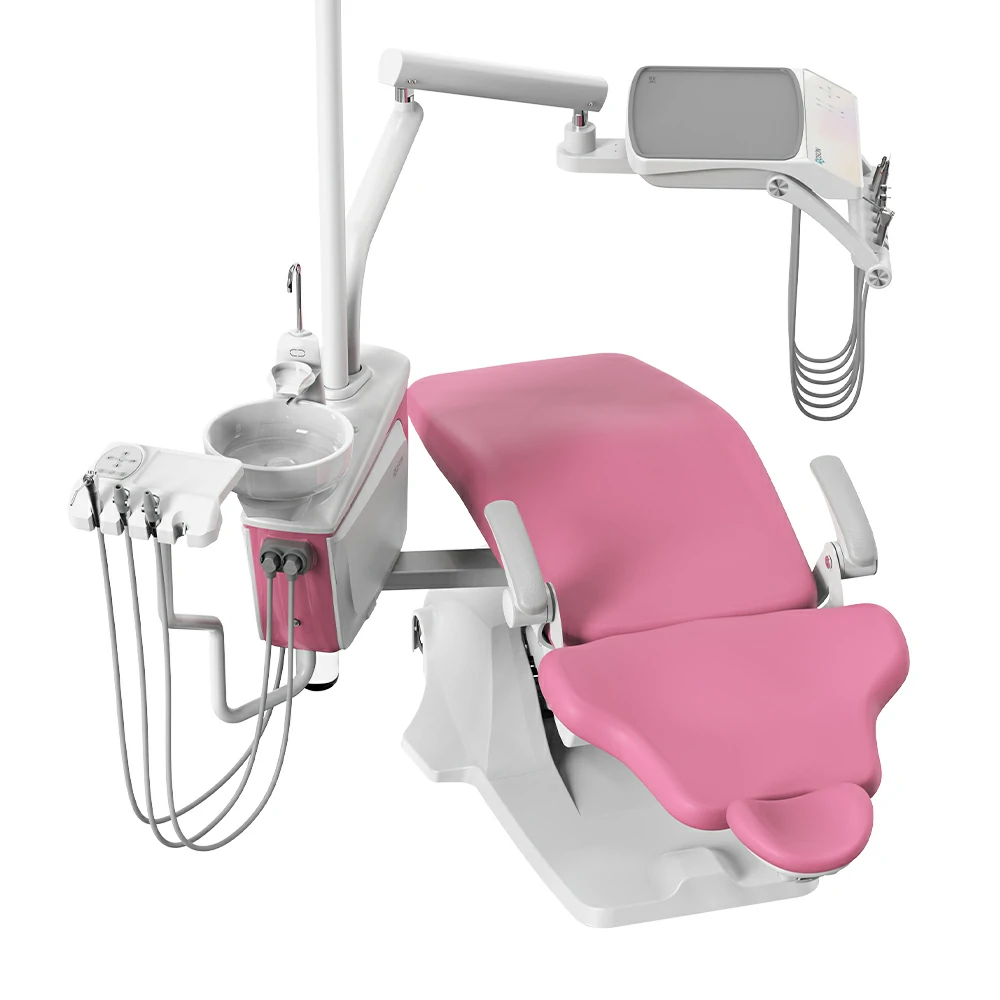
The choice between a conventional treatment setup and newer dental chairs for sale is not simply a decision between old and new equipment. The more important difference lies in how the chair connects patient positioning, instrument delivery, lighting, water, suction, controls, and operator workflow.
Traditional configurations can remain practical where straightforward operation is the priority. Modern units, meanwhile, can combine more functions around the treatment position. For clinics replacing equipment or fitting new operatories, the better choice depends on which arrangement supports the intended workflow without adding unnecessary complexity.
The Real Difference Is More Than Chair Movement
A traditional dental chair generally serves as the patient-positioning platform, while surrounding equipment provides many of the treatment functions. Modern integrated units can bring more of those functions into one coordinated system.
Roson’s current chair portfolio demonstrates this broader approach. Its range includes Classic, Professional, Fashion, Flagship, Security Master, and Smart models, with configurations differing in controls, delivery systems, lighting, water functions, and integrated treatment equipment.
That distinction changes how buyers should compare equipment. Chair upholstery, lift mechanism, and patient positioning remain important, but they are only part of the evaluation. Instrument placement and the way dentists and assistants access controls can have an equally direct effect on the treatment process.
Consequently, the right comparison asks how the entire operatory works around the patient rather than judging the chair as an isolated piece of furniture.
Where Traditional Dental Chairs Still Make Sense
Traditional arrangements have an obvious advantage: familiarity. Dentists and assistants who already work with a straightforward chair-and-equipment layout may not need extensive changes to their established routines.
A simpler configuration can also make sense when the clinic does not require numerous integrated instruments. Adding functions that will rarely be used does not necessarily improve the treatment environment. For a practice focused on routine procedures, reliable chair positioning and access to essential equipment may be sufficient.
Maintenance considerations can also influence the decision. A less integrated arrangement may allow individual components to be serviced or replaced without changing the configuration of the entire treatment unit. That can be relevant for smaller practices or facilities where minimizing operational disruption is a priority.
However, “traditional” does not necessarily mean technically basic. Even a conventional unit can include electric chair movement, adjustable lighting, suction, water supply, foot controls, an instrument tray, and an assistant control system. The distinction is therefore one of integration and workflow rather than simply equipment age.
What Modern Dental Chairs for Sale Add to the Operatory
The main advantage of contemporary systems is the ability to consolidate functions around the treatment position.
Roson’s N1, for example, is specified with a 24V noiseless DC motor, sensor dental LED light, multifunctional assistant device, instrument tray, three-way syringe, suction, LED X-ray viewer, dentist stool, warm-water system, pure-water system, and ceramic spittoon.
The N2+ provides another example of an integrated configuration. Its listed features include automatic water supply, a low-mounted instrument tray, rotatable ceramic spittoon, multifunction foot control, saliva suction, LED lighting, X-ray viewer, and built-in water bottles.
For a dentist, the practical value is not the number of features printed on a brochure. It is the concentration of frequently used functions within reach. Foot controls can reduce the need to manipulate equipment by hand, while adjustable delivery systems can be positioned according to operator preference.
Modern systems can also provide more configuration choices. The N1 supports over-the-patient, swing-mounted, and cart-mounted handpiece placement, while upholstery and color selections can also be specified.
This flexibility makes contemporary dental chairs for sale particularly relevant to clinics designing operatories around specific working styles rather than adopting one fixed layout.
The Trade-Off: More Integration Means More Decisions
Greater integration is useful only when the configuration is appropriate. A buyer considering a modern unit has more choices to evaluate: delivery position, instrument selection, control arrangement, water systems, lighting, upholstery, and optional equipment.
Roson’s 6210 configuration illustrates how equipment can be combined with additional treatment functions. Its listed configuration includes an ultrasonic scaler and curing light in addition to the chair, lighting, suction, water systems, instrument tray, and assistant table.
That creates a potential advantage for a clinic that wants several commonly used functions consolidated into one unit. It can be less compelling if the practice already owns compatible standalone equipment or prefers a highly modular setup.
Support should also be part of the comparison. A complex treatment unit requires buyers to understand installation, maintenance, replacement components, and local technical assistance. The manufacturer’s FAQ describes quality-control processes, production traceability, and ISO 9001 and ISO 13485 certification. Buyers should still verify that the exact configuration and support arrangements meet the requirements of their market.
Which Option Fits the Clinic Better?
The better dental chair depends on the operating environment.
A traditional arrangement can be a sensible choice for a practice that values familiarity, straightforward maintenance, and separation between the chair and supporting equipment. It can also suit clinics that already have an established operatory layout and do not need additional integrated functions.
Modern dental chairs for sale become more attractive when the clinic wants a coordinated treatment platform. Integrated lighting, suction, water systems, foot controls, instrument delivery, and optional treatment devices can reduce the need to manage separate components around the patient.
By offering both standard and advanced setups, Roson enables buyers to tailor their equipment to specific integration needs rather than forcing a one-size-fits-all model.
Consequently, procurement teams should base their choices on actual workflow needs rather than surface appearances or the bias that newer automatically means better. Integrated units deliver true value when their extra features align with daily operator habits. Conversely, when simplicity and modularity take priority, traditional layouts often prove to be the more practical choice.
The best purchase is ultimately the configuration that solves the clinic’s actual operating requirements. Comparing the chair, delivery system, controls, supporting equipment, customization options, and service expectations together gives buyers a more reliable answer than choosing solely between “modern” and “traditional.”
